Showing posts with label mac. Show all posts

Saturday, February 13, 2016

Stop Streaming Torrents, Torrents-Time Browser Plugin Is Vulnerable To XSS & MITM.


Torrents Time is a new technology that allows users to instantly download and watch torrented material right inside their browser. Users who want to use Torrents Time have to download its installer, which sets up a local Node.js server and also adds an extension to your browser.

According to developer,Andrew Sampson, the Torrents Time browser plugin that allows users to stream multimedia torrents in real time inside their browser is plagued by various security issues that range from XSS to MitM attacks.

Sites that employ it, like TPB and KAT, have to host a few files that allow the plugins to tap into their torrents database and query for torrent seeds and other data.Sampson says that this is where Torrents-Time plugin is vulnerable.


According to him, Torrents Time fails to implement CORS, leaves users vulnerable to attack. It does not properly implement CORS (Cross-Origin Resource Sharing), a crucial Web security mechanism that prevents resources from being loaded from different domains.

Sampson says that a potential hacker can create a specially crafted website loaded with malware to mimic a regular page (popup) created by TBP or KAT, and add their own malicious code, which, because of an improper CORS implementation, would be allowed to execute.

Another thing is that the JavaScript code delivered to the user’s browser by Torrents-Time could trickle down to the local Torrents Time Node.js server and query its API for details about the user. This function can be abused by advertisers to randomly check Internet users for those who have Torrent Time installed, and then collect information that can be used to track them online.

He also discovered that Torrents Time could also spy on users by tracking its users’ activity (IP, location, user agent, cookie, watched torrents, etc.).

According to Sampson, Mac users are at even more risk from using Torrents Time . This is because Torrents Time app for Mac runs as a root user.
A potential attacker abuses the app and installs malware on it.  This is possible because Sampson discovered that the Torrent Time app could be forced to redownload the browser plugins at command and users will be forced to download a file from the attacker’s own server, probably infected with malware.

Sampson also said that, attackers could use malicious JS code to ping your local Torrents Time Node.js server with exactly 1024 bytes and force your CPU usage to remain between 50%-80% until the Torrents Time service is shut down or crashes.

Here's the Proof-Of-Concept code uploaded by Sampson.

Monday, January 4, 2016

Ransom32 - The First Ransomware based on Javascript & Cross Platform Compatibility


A new Ransomware as a Service, or RaaS, called Ransom32 has been discovered that for the first time uses a ransomware written in Javascript. Located on an underground TOR site, the Ransom32 RaaS is a simple, but efficient, service where anyone can download and distribute their very own copy of the ransomware executable as long as they have a bitcoin address.  For offering this service, the developers of Ransom32 take a 25% cut of all ransom payments and then forward the rest to the bitcoin address an affiliate entered when they joined the affiliate program.


The first Javascript Ransomware

What makes this ransomware unique is that it is the first ransomware programmed entirely in Javascript, HTML, and CSS.  This ransomware uses the NW.js platform that allows developers to create native applications for Linux, Mac, and Windows using HTML5, CSS3, Javascript, and WebGL.  Using NW.js a developer can take their scripts and html and package them into a Chromium executable that when executed automatically runs the embedded JS and HTML.

What makes the Ransom32 RaaS so scary is that Javscript and HTML are cross-platform and run equally as well on Macs and Linux as they do in Windows. This means that with some minor tweaks, the Ransom32 developers could easily make NW.js packages for Linux and Mac computer. Though there does not seem to be any indication that this is being done as of yet, doing so would be trivial.

It is inevitable that ransomware will be created for operating systems other than Windows Using a platform like NW.js just brings us one steps closer.

First Glance:

Ransom32 was first reported by infected users  Fabian Wosar of Emsisoft and Security Researcher xXToffeeXx searched for a sample they stumbled upon the Ransom32 TOR affiliate service. It is very easy for an affiliate to join this RaaS as all that is needed is a bitcoin address that the affiliate's share of the ransom payment will be sent to.


Once a bitcoin address is submitted, an affiliate will be shown an Affiliate Console where they can see the statistics for their personal distribution campaign and configure various settings on how the ransomware should be executed.


This affiliate console will contain statistics that include the number of people that successfully installed the client, the number of people that were shown the lock screen when the encryption was completed, the number of bitcoin transactions to your address, and the amount of ransom payments sent to your payout address.
In the console an affiliate will also be able to configure various settings for how the Ransom32 executable should run.

The listed settings and the Ransom32 developer's descriptions for them are:
BTC amount to ask:  BTC amount to ask. Don't be too greedy or people will not pay.

Fully lock the computer: By default the lockscreen will popup each X seconds after being minimized. You can configure it so the user will not be able to minimize the lock screen. The downside is that will be more difficult for the users to check that their files were truly encrypted and also they will need to find another method to send your Bitcoins as the browser will be blocked too.

Low CPU Usage: Will encrypt files at 0-25% speed while the lock window is not shown, so the process won't be noticeable in the task manager by an advanced user because of high CPU consumption.

Show the lockscreen before encrypting: By default the client will show the lockscreen after encrypting part of the files in the computer (filesize under 50 Mb) and continue encrypting in the background. You can tell it to show the lockscreen right after installing, before encrypting any file in the background. The downside is that if the user tries to check his files just when the window pops in, he will notice that any file has been encrypted (although it is encrypting while is running).

Show a message Box: This box will be shown before installing and before any latent timeout is applied.

Latent Timeout: The client will "wake up", connect to the server and start encrypting after this amount of seconds passed after installing. The client won't connect to the server until it wakes up (more stealth), so you won't notice an install in your stats until this moment. NOTE: The client will not save the latent info as-is. Will be mixed with some data so is not understandable at first sight. Because of this, expect a 0-4 minutes drift to your timeout.


Once an affiliate has configured the ransomware to their liking, they simply need to click on the download button to generate and download their customized copy of Ransom32.  This download is a self-extracting RAR file that weighs in at 22MB and when extracted totals over 67MB. Once the customized ransomware is downloaded, it is up to the affiliate to determine how it should be distributed.
An important feature for any "commerce" campaign is to be able to track its performance. As only a bitcoin address is required to join the affiliate program, it is very easy for an affiliate to track each distribution method's performance by simply using a different address for each campaign.


Encryption Process

The download that is generated by the affiliate is actually a 22MB self-extracting archive that when extracted is over 67MB.  When this executable is run, it will extract numerous files into the C:\Users\User\AppData\Roaming\Chrome Browser folder and creates a shortcut in the Start Menu's Startup Folder called ChromeService so that the ransomware starts at login.  The shortcut points to a chrome.exe executable that is actually a NW.js package that contains Javascript code that will encrypt the victim's data and then display a ransom note.
The files extracted into the Chome Browser folder are:
  • chrome - The Chromium license agreement.
  • chrome.exe - This is the main executable for the malware and is a packaged NW.js application bundled with Chromium.
  • ffmpegsumo.dll - HTML5 video decoder DLL that is bundled with Chromium.
  • - The settings file that contains various information used by the malware. This information includes the affiliate's ransom amount, bitcoin address that they receive payments on, and error message that is shown in a messagebox if the Show a message Box setting was enabled.
  • icudtl.dat - File used by Chromium
  • locales - Folder containing various language packs used by Chrome.
  • msgbox.vbs - The messagebox displayed if the affiliate enabled the Show a message Box setting.
  • nw.pak - Required for the NW.JS platform.
  • rundll32.exe - Renamed TOR executable so that the malware can communicate with the TOR Command and Control server.
  • s.exe - Renamed Shortcut.exe from OptimumX. This is a legitimate program used by the malware to create the ChromeService shortcut in the Startup folder.
  • u.vbs - A VBS script that deletes a specified folder and its contents.


 At glance it looks suspiciously like a copy of the famous browser "Chrome". The forgery is revealed only in that it does not have a digital signature and version information is missing. Further analysis they expose as a packed NW.js application.


When encrypting your data, Ransom32 will target only specific file extensions and encrypt them using AES encryption. The targeted file extensions are:

* .jpg, * .jpeg, * .raw, * .tif, * .gif, * .png, * .bmp, * .3dm, * .max, * .accdb, * .db, * .dbf, *. mdb, * .pdb, * .sql, *. * SAV *, *. * SPV *, *. * grle *, *. * MLX *, *. * SV5 *, *. * game *, *. * Slot *, * .dwg, * .dxf, * .c, * .cpp, * .cs, * .h, * .php, * .asp, * .rb, * .java, * .jar, * .class, * .aaf, * .aep, * .aepx, * .PLB, * .prel, * .prproj, * .aet, * .ppj, * .psd, * .indd, * .indl, * .indt, *. indb, * .inx, * .idml, * .pmd, * .xqx, * .xqx, * .ai, * .eps, * .ps, * .svg, * .swf, * .fla, * .as3, * .as, * .txt, * .doc, * .dot, * .docx, * .docm, * .dotx, * .dotm, * .docb, * .rtf, * .wpd, .wps, *. msg, * .pdf, * .xls, * .xlt, * .xlm, * .xlsx, * .xlsm, * .xltx, * .xltm, * .xlsb, * .xla, * .xlam, * .xll, * .xlw, * .ppt, * .pot, * .pps, * .pptx, * .pptm, * .potx, * .potm, * .ppam, * .ppsx, * .ppsm, * .sldx, *. sldm, * .wav, * .mp3, * .aif, * .iff, * .m3u, * .m4u, * .mid, * .mpa, * .wma, * .ra, * .avi, * .mov, * .mp4, * .3gp, * .mpeg, * .3g2, * .asf, * .asx, * .flv, * .mpg, * .wmv, * .vob, * .m3u8, * .csv, *. EFX, * .sdf, * .vcf, * .xml, * .ses, * .dat


 Notice how Ransom32 also uses wild cards in the targeted file extensions. This allows the program to to target a greater variety of extensions. For example, with the .*sav* extension, not only will .sav files be targeted, but also files ending with .save, .gamesave, or .mysaves will be encrypted as well.  When encrypting data files, it does not rename a victim's files and will not encrypt any files located in the following folders:

  • : \ Windows \
  • : \ winnt \
  • ProgramData \
  • boat\
  • temp \
  • tmp \
  • $ RECYCLE.BIN \ 


When it has finished encrypting your data it will display the Ransom32 ransom lock screen/ransom note as shown below.


The Ransom32 lock screen will display information that tells the victim what has happened to their files, how to pay the ransom, the ransom amount, and the bitcoin address a ransom payment is sent to. The language used by the lock screen is shown in either English or Spanish, with the default appearing to be English. Last, but not least, this screen allows you to decrypt one file for free to prove that it can be done.


 Encryption is performed under the AES (Advanced Encryption Standard) 128-bit key with the CTR mode. For each file, a new key is created. This in turn with the RSA algorithm and a public key encrypted, which was retrieved in the first communication with the C2 server.
 

Extract from the individual protocol exchange between Ransom32 and the C2 server to Bitcoin address (violet) and retrieve public keys (length in yellow, key in green).
 
The encrypted AES key is used together with the AES-encrypted data in the - saved file - now also encrypted.
 
The malware also offers to decrypt a single file again to prove the victim that the malware developer encryption can actually pick up again. For this purpose it sends the encrypted AES key of the selected file to the C2 server, which then sends back the decrypted AES key for the file.


Files installed by Ransom32:

%Temp%\nw3932_17475
%AppData%\Microsoft\Windows\Start Menu\Programs\Startup\ChromeService.lnk
%AppData%\Chrome Browser\
%AppData%\Chrome Browser\.chrome\
%AppData%\Chrome Browser\.chrome\cached-certs
%AppData%\Chrome Browser\.chrome\cached-microdesc-consensus
%AppData%\Chrome Browser\.chrome\cached-microdescs
%AppData%\Chrome Browser\.chrome\cached-microdescs.new
%AppData%\Chrome Browser\.chrome\lock
%AppData%\Chrome Browser\.chrome\state
%AppData%\Chrome Browser\chrome
%AppData%\Chrome Browser\chrome.exe
%AppData%\Chrome Browser\ffmpegsumo.dll
%AppData%\Chrome Browser\g
%AppData%\Chrome Browser\icudtl.dat
%AppData%\Chrome Browser\locales\
%AppData%\Chrome Browser\msgbox.vbs
%AppData%\Chrome Browser\n.l
%AppData%\Chrome Browser\n.q
%AppData%\Chrome Browser\nw.pak
%AppData%\Chrome Browser\rundll32.exe
%AppData%\Chrome Browser\s.exe
%AppData%\Chrome Browser\u.vbs


Unfortunately, at this time there is no known way to decrypt the files for free, but if anything changes we will post about it here.


Source: Emsisoft & BleepingComputer


Friday, November 6, 2015

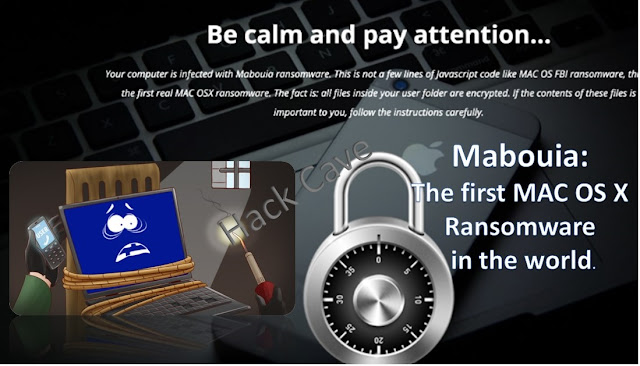
Mabouia: The first MAC OS X ransomware

Mabouia: The first MAC OS X ransomware
It is a myth that the Apple's MACs are safer and affected less by malwares. On contrary,MAC OS is equally affected by viruses and malware attacks and there are several critical vulnerabilities discovered recently. However ransomware targetting MAC OS was not previously known. Ransomware is a type of malicious software designed to block access to a computer system until a sum of money is paid.

Mabouia: The first MAC OS X ransomware


Ransomware encrypts files stored on the machine, then displays a message informing the user that a decryption key must be purchased in order to recover access to the files held at ransom. A Brazilian Cybersecurity Researcher known as Rafael Salema Marques (@pegabizu),published yesterday a proof of concept about the existence of MAC OS ransomware. It is called Mabouia,the first ransomware that targets MAC OS X. This is a real and serious one, unlike the MAC OS FBI Ransomware  which was just a few lines of javascript code and essentialy a prank.

Mabounia Ransomware-How It Works


Mabounia Ransomware is coded in C++ and uses the Cryptographic Algorithm XTEA  with 32 roundsto encrypt the user files. Mabounia ransomware will only modify the user’s personal files hence it does not need superuser privileges for the execution of malicious code.Thus infection occurs with just one click.

MAC Users Beware.


According to the creator of Mabouia,Mac users are a good target for ransomware, because generally they have a higher purchasing power and use the computer in a superficial way. The researcher’s goal is to alert the 66 million users of Mac OS X about the dangers of such a ransomware.

How Mabounia Ransomware affects MAC OS X Can be watched live from the below link. (PoC)